
How the pre-owned luxury watch market has moved from the 2021 spike through the 2023 correction, and where things sit in mid-2026. Named references, real price movements, no spin.
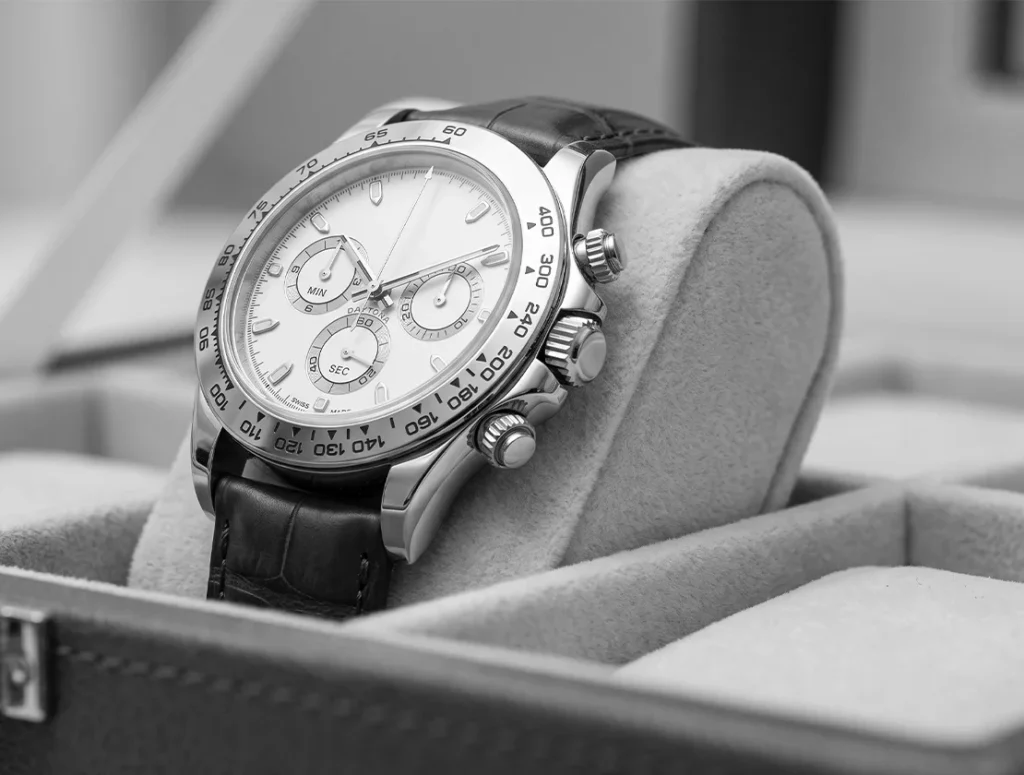
The 2021 spike was real (pandemic savings, crypto wealth, Nautilus 5711 discontinuation), the 2023 correction gave back 20 to 40 percent of those gains depending on the reference, and mid-2026 looks like stabilization at a new normal that sits above pre-2021 levels but well below the 2022 peaks. The references that held best have the deepest collector demand and the most constrained supply (Daytona, Nautilus, Royal Oak). The ones that corrected hardest were bid up by momentum buyers rather than collectors. Timing the market is a losing game for individual sellers. Sell when your situation calls for it, not when you think the chart looks right.
Three forces converged in 2021 and pushed pre-owned luxury watch prices to levels the market had never seen.
First, pandemic savings. Consumers who could not travel, dine out, or spend on experiences redirected discretionary income toward hard assets. Watches, along with sneakers, art, and crypto, absorbed that liquidity. The demographic was broad: first-time collectors, experienced buyers expanding their collections, and a new generation that discovered watches through Instagram and YouTube during lockdown.
Second, the crypto-to-watch pipeline. A generation of crypto gains in 2020 and 2021 flowed directly into the watch market. Dealers in Miami, Dubai, and Singapore reported buyers paying for Nautilus and Daytona pieces in USDT and BTC at a pace they had never seen. This was not a rumor; it was visible in transaction records across the industry.
Third, the Nautilus 5711 discontinuation. In January 2021, Patek Philippe announced the olive-green-dial 5711/1A-014 as a limited farewell edition, signaling the end of the 5711 line. Prices on existing 5711s doubled within months. The halo effect was enormous: if the defining stainless-steel luxury sports watch was being discontinued, every comparable piece across every brand gained perceived scarcity. A Submariner 116610LN that traded at $9,000 in January 2021 was selling at $14,000 to $15,000 by December 2021. A Daytona 116500LN went from $25,000 to north of $40,000. The market felt unstoppable. It was not.
By mid-2022, prices had peaked. The correction started slowly: pieces taking longer to sell, listing prices softening by 5 percent, then 10. Then it accelerated through Q4 2022 and into 2023.
The crypto crash removed one of the three demand pillars overnight. Buyers who had converted BTC gains into watches were now underwater on their crypto positions and in no position to buy more watches. Rising interest rates made hard assets less attractive relative to yield-bearing instruments: why park $30,000 in a Daytona when a savings account is paying 4 to 5 percent? And the momentum buyers who had driven the steepest part of the climb exited as fast as they had entered, because they were never collectors. They were speculators.
The correction was not uniform. References that had been bid up primarily by momentum (AP Royal Oak Offshore limited editions, certain Rolex GMT and Submariner configurations that were fashionable but never classics) corrected 30 to 40 percent from peak. References with deep collector bases (Daytona, Nautilus, Royal Oak 15500ST) corrected 15 to 25 percent but stabilized earlier because the underlying demand was real. By late 2023, the freefall feeling was over, but prices had not recovered to 2022 levels and showed no signs of doing so.
The market in mid-2026 is best described as stabilized at a new normal. Most references sit 10 to 20 percent above their pre-2021 levels but 20 to 35 percent below their 2022 peaks. Transaction volumes have recovered (more pieces are changing hands now than in the correction trough of early 2023), but the frenzy is gone. Buyers are more patient, sellers are more realistic, and dealers are operating on tighter margins.
Some specific data points. Submariner 116610LN: traded at $8,000 to $9,000 pre-2021, peaked at $14,000 to $15,000, now sits around $11,000 to $12,500. Daytona 116500LN: $22,000 to $25,000 pre-2021, peaked above $40,000, now $30,000 to $34,000. Nautilus 5711/1A-010 (blue): $60,000 to $70,000 pre-discontinuation, peaked above $180,000, now $130,000 to $150,000. Datejust 126334: relatively stable throughout, because it was never a speculative target. Moved from $9,000 to $11,000 pre-2021 to $11,000 to $13,000 at peak, now $10,500 to $12,500.
The pattern is clear: the more a reference was driven by genuine collector demand (as opposed to speculative momentum), the less it corrected and the faster it stabilized.
Held well: Rolex Daytona (both Panda and reverse-Panda configurations), Patek Nautilus 5711 (all dial variants), AP Royal Oak 15500ST and the discontinued 15202ST, Rolex GMT-Master II 126710BLNR (Batman on jubilee). These references share three traits: deep collector demand that predates the spike, genuinely constrained supply (Rolex and Patek do not overproduce relative to waitlist demand), and cultural cachet that outlasts market cycles. They corrected from peak but stabilized well above pre-2021 levels.
Corrected significantly: AP Royal Oak Offshore limited editions (especially color and material variants that were trend-driven), the Rolex Submariner 116610LV (Hulk) which was priced more on hype than on collector fundamentals once the initial discontinuation premium faded, and Tudor Black Bay models that were dragged up by the rising tide and have since settled back near their pre-2021 trading range.
The lesson is not complicated: references that are classics trade on fundamentals. References that were momentarily fashionable trade on sentiment, and sentiment is fragile.
The honest answer: timing the market is a losing game for individual sellers. The 2021 spike was obvious only in retrospect. No one knew at the time that December 2021 was the peak, and anyone who waited for a higher price in early 2022 watched values decline instead. The 2023 correction felt like it might continue indefinitely, and anyone who panic-sold in early 2023 locked in the worst prices of the cycle.
If you are selling because you need the cash, or because the watch no longer fits your life, the current market is reasonable. Prices are stable, transaction volumes are healthy, and you are selling above pre-2021 levels on most references. You are not selling at the peak, but the peak was an anomaly, not a baseline.
If you are selling because you think prices are about to drop further, that is a speculative bet, and speculative bets on watch prices have a poor track record even among professional dealers. If you are holding because you think prices will return to 2022 levels, that is also speculative, and most market data suggests those levels were the anomaly, not the norm. The soundest approach is to ignore the macro and focus on your own situation: do you want the watch, or do you want what the cash could do for you? Answer that question and the timing takes care of itself.
How Much Is My Rolex Worth
Sell vs Consign vs Trade
If the analysis above has helped you decide, the next step is simple. Send us the reference and a few photos, and we will give you a firm number at current market levels. No cost, no obligation. The market data in this guide gives you context; a specific offer gives you a decision point.