
The honest answer: it depends on the reference, the condition, the papers, and the current market. This guide breaks each factor down with specific numbers.
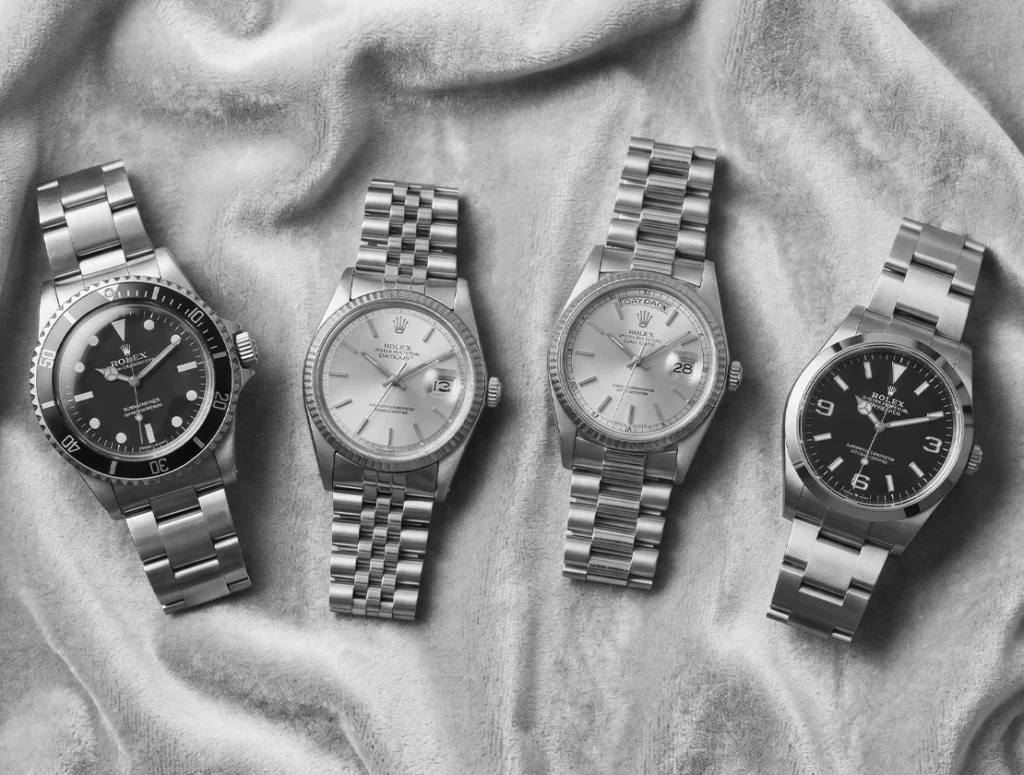
A Rolex’s market value comes down to four things: the reference number (which model and generation), the condition (case sharpness, dial originality, movement service history), whether original box and papers are present, and where recent comparable sales have landed. If you email three dealers with photos of the same Submariner, expect offers that vary 15 to 30 percent. That spread is not random and it is not a sign that someone is lowballing you. Each dealer has a different customer waiting, different overhead, and a different margin structure. The sections below walk through each factor with worked examples on a Submariner 116610LN, a Daytona 116500LN, and a Datejust 126334.
The six-digit (or alphanumeric) reference number on the case between the lugs at 12 o’clock is the first thing any dealer checks. It tells us the model family, the bezel material, the dial variant, and the movement generation. Two watches that look nearly identical on the wrist can trade thousands apart because of this number.
Take the Submariner Date. A 116610LN (steel, black ceramic bezel, caliber 3135) trades in the $11,000 to $12,500 range in mid-2026 with a full set in excellent condition. The visually similar 126610LN (caliber 3235, slightly larger case, current production) trades $1,000 to $2,000 higher because of the newer movement and the current-production premium. Go further back to the five-digit 16610 (tritium dial, caliber 3135 without Parachrom hairspring) and you are in a different market entirely: $9,500 to $11,000 with a floor that has been remarkably stable because vintage Submariner demand has its own collector base.
Where to find your reference: between the lugs at the 12 o’clock position, visible when you remove the bracelet end link. If you would rather not pop the bracelet, check the original warranty card, the purchase receipt, or the caseback engraving (post-2005 Rolex models engrave the reference on the inner caseback).
Within any reference, condition is the biggest single swing factor. A 116610LN in excellent condition (minimal desk-diving marks on the bracelet, unpolished case with original factory finishing on the lugs, original hands and dial, no moisture marks under the crystal) might trade at $11,000 to $12,500. The same reference with heavy wear, polished lugs that have lost their original brushed finish, and a refinished or replaced dial drops to $9,000 to $10,000. That is a 20 percent spread on the exact same watch.
What dealers specifically look at: case sharpness (have the lugs been polished, and if so, how much metal was removed?), dial originality (has it been refinished? is the lume aging consistently?), movement service history (a recent Rolex-certified service adds confidence; a missing service history introduces risk), crystal condition (scratched sapphire is replaceable cheaply; a cracked crystal suggests impact), and bracelet stretch (stretched links and a loose clasp drop the grade).
Worked example at a higher price tier: Daytona 116500LN (steel, ceramic bezel, Panda or reverse-Panda dial) in excellent condition with full set trades around $30,000 to $34,000 in mid-2026. The same reference with polished lugs and a replaced bezel insert sits $4,000 to $6,000 lower. That condition gap alone is worth more than most entire watches.
Original box and papers (warranty card with matching serial, original hang tags, outer and inner box) add a measurable premium for Rolex. On a modern Submariner, full set over watch-only adds $500 to $1,500. On a Daytona, the premium is wider: $1,500 to $3,000, because Daytona buyers are more documentation-sensitive and the watch sits at a price tier where provenance carries more weight. On a Datejust, the premium is narrower: $300 to $800. Datejusts are more common, and buyers at the $8,000 to $12,000 tier are less likely to require a full set.
The warranty card matters most. If you have the card but lost the box, you retain most of the premium. If you have the box but not the card, the premium shrinks significantly because the card is the only document that ties the serial number to the original purchase. If you have neither, you are selling watch-only. That is still perfectly fine and we buy watch-only Rolex pieces every week, but the offer adjusts accordingly.
Related guide:
Related page:
Market value is ultimately what the last few comparable pieces sold for. Not what they were listed at. Listing prices in the pre-owned Rolex market run 10 to 20 percent above actual transaction prices, which is why you should never use listed-price averages as your baseline.
Where to find real sold data: Chrono24 offers a sold-listings filter that shows actual transaction prices (not asking prices). WatchCharts aggregates pricing data into reference-level indices. And dealer-network pricing, which is not public, reflects what dealers pay each other for pieces they intend to resell. Any established dealer can reference this.
Worked example: Datejust 41 126334 (steel and white-gold fluted bezel, jubilee bracelet, blue dial) in excellent condition with full set. Chrono24 sold listings in May and June 2026 cluster around $10,800 to $12,200. Dealer-to-dealer pricing for the same piece sits around $9,500 to $10,500. A consumer selling to a dealer should expect an offer somewhere in the dealer-to-dealer range, because the dealer needs margin to authenticate, hold, market, and resell the piece.
If you email three dealers with photos of the same Submariner, you will get three different numbers. The spread is typically 15 to 30 percent between the lowest and highest. This is not because two of the three are trying to undercut you. Each dealer has a different cost structure and a different customer base.
The dealer with a retail buyer already waiting for that exact reference can pay more, because the piece will not sit in inventory. The dealer without a waiting buyer pays less, because they are accounting for holding cost and the risk that the market moves before the piece sells. Both offers are legitimate.
What this means for you: get multiple offers, but do not assume the highest number is automatically the best deal. Ask about timeline (how fast do they pay once they have the watch?), process (do they need to see it in person or do they buy from photos and then verify on arrival?), and payment method (same-day wire, check that takes a week, crypto that clears within the hour?). A slightly lower offer with same-day wire, insured shipping both ways, and a clear authentication process might net you more comfort and less risk than a higher number from an unknown buyer.
Watch Valuation Explained
Sell vs Consign vs Trade
Guide-level estimates are useful for orientation, but they are not a substitute for a specific evaluation of your specific watch. Every Rolex has its own story: when it was serviced, how it was worn, what documentation survived, and where the market sits this week for that exact reference.
For a specific number on your Rolex, send us the reference, a few photos (dial, caseback, and any papers you have), and a note on the condition. We respond within a business day, typically with a firm number rather than a range. Same-day payment by wire or USDT if you accept. No cost to submit, no obligation to proceed.