
Three ways to move a luxury watch. Each has a different timeline, a different payout, and a different best-for scenario. This guide shows you the math on all three.
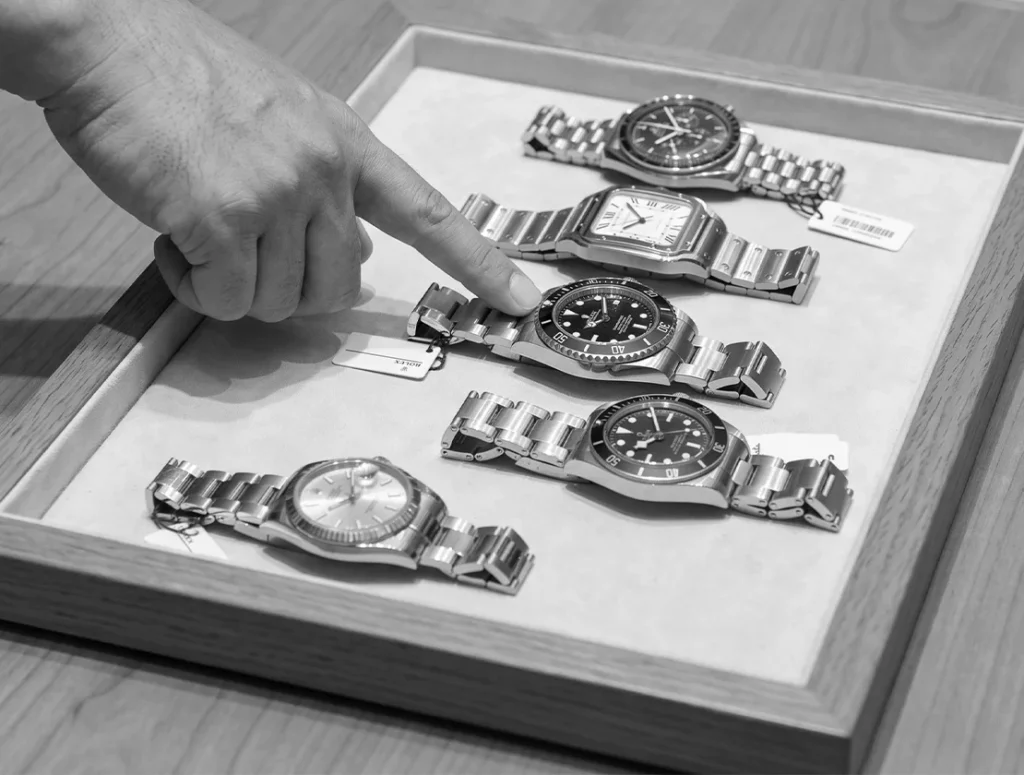
Sell outright: fastest (same-day payment), lowest total payout (dealer-buy price).
Consignment: highest eventual payout (near retail), but takes weeks or months and you carry the market risk while the watch sits. Trade-in: lands in between, works best when you are buying another watch anyway because you capture value as credit rather than cash. Each path has a real cost. The comparison table and worked math below use a $15,000-retail Submariner to show what each option actually nets you.
| Timeline | Same day | 2 to 12 weeks | Same day (if buying) |
|---|---|---|---|
| Payout | Lowest — $10,000 to $11,000 on a $15k piece | Highest — $12,000 to $13,500 after fees | Same day (if buying) |
| Payment | Cash, wire, or USDT | Cash after sale | Credit toward purchase |
| Risk | None — you are done | Market moves while listed | None if buying same day |
| Best for | Need cash now; want certainty; estates | Want max return; can wait; high-value pieces | Upgrading; switching within same dealer |
| When it doesn't work | When the piece is high-value and you can afford to wait | When you need cash this week when the piece is mid-range | When you are not buying another watch |
How it works: you send photos and the reference number, the dealer quotes a firm price, you ship insured (or bring it in person), the dealer authenticates the piece on arrival, and you get paid the same day by wire or USDT. The whole process can close in 48 hours if you move quickly, or you can take a week to think about it. No listing period, no waiting for a buyer, no market risk after you accept.
The payout is dealer-buy price. On a pre-owned Submariner in the $12,000 to $15,000 retail range, dealer-buy sits around $10,000 to $11,500. That 15 to 25 percent gap is the dealer margin: it covers authentication labor, holding cost (average piece sits in inventory 30 to 90 days), marketing, and resale risk. The gap is not profit padding; it is the cost of running the operation that makes the instant-liquidity offer possible.
Worked example: your Submariner retails at $14,000 pre-owned. A dealer offers $11,000 outright. You accept, ship insured, and receive $11,000 by wire the day the watch arrives. Total elapsed time: 3 days. Total cost to you: the $3,000 spread between retail and dealer-buy. What you got for that $3,000: speed, certainty, and zero listing risk.
Best for: people who need liquidity now, people who dislike uncertainty or negotiation, estate and inherited-watch situations where the executor wants closure, and anyone selling a mid-range piece where consignment math does not pencil (see next section).
How it works: you are buying a watch from the same dealer and using your current watch as partial payment. The dealer credits your old watch at a value between outright-buy and retail. Why do they credit more than outright-buy? Because they save the marketing and holding cost of selling it separately: the piece goes straight from your wrist to the next buyer (or into their inventory at a lower acquisition cost).
Worked example: your Submariner is credited at $11,500 toward a $32,000 Daytona. You pay $20,500 out of pocket instead of $32,000. If you had sold outright ($11,000) and then bought the Daytona at full price ($32,000 minus $11,000 = $21,000 out of pocket), the trade-in saved you $500 and skipped a step. The savings get larger on higher-value trade-ins: a $40,000 Nautilus traded toward a $65,000 piece might receive $42,000 to $44,000 in credit, saving $2,000 to $4,000 versus the sell-then-buy path.
Advantages: simplicity (one transaction instead of two), typically better value than outright sale. Disadvantages: only works if you are buying from the same dealer, and the credit value is not transferable to cash. If you decide not to buy, you are back to the outright-sale or consignment path.
How Much Is My Rolex Worth
Watch Valuation Explained
All three paths start the same way: telling us what you have. Send the reference and a few photos, and we will quote all three options: an outright price, consignment terms, and trade-in credit if you are looking at something in our catalog. One submission, three numbers. No cost to ask, no obligation to proceed with any of them.