
What dealers actually look at when they pick up a watch and start quoting. Not a pricing guide for a specific brand. A window into the process itself.
Dealers check four things in a specific order: the reference number and movement (which tells them the model, generation, and caliber), the condition and originality (which determines where the piece falls within that reference’s trading range), the documentation (box, papers, service records), and recent market comparables (what similar pieces actually sold for, not what they were listed at). The interplay between these four factors is why two watches with the same reference number can trade 20 to 30 percent apart. The sections below explain what each check actually involves and what it means for the number you are quoted.
Every valuation follows the same sequence, whether the watch is a $5,000 Tudor or a $200,000 Patek. The dealer is mentally building a grade for the piece by checking four layers.
First, the reference and movement. The reference number between the lugs tells the dealer what the piece is supposed to be. The movement inside confirms it. A mismatch between the external reference and the internal caliber is a red flag: it could mean the case or dial has been swapped from another piece. Once the reference and movement check out, the dealer knows the model family, the production generation, and the caliber. This sets the baseline trading range.
Second, condition and originality. This is where most of the price variation within a reference comes from. Unpolished case, original dial, matching hands, clean bracelet: top of the range. Polished case, replaced dial, aftermarket parts, stretched bracelet: bottom of the range. The next two sections go deeper on these.
Third, documentation. Box, papers, warranty card, service records. The warranty card matters most because it ties the serial number to the original purchase and confirms the watch is not stolen property. Full documentation adds a premium; missing documentation adjusts the offer downward (how much depends on the brand and the piece; see our box and papers guide for brand-by-brand detail).
Fourth, market comparables. What have similar pieces actually sold for in the last 30 to 90 days? Not listed prices, which run 10 to 20 percent above actual transaction prices. A dealer references sold data from Chrono24, WatchCharts, auction results, and their own network’s transaction history. This anchors the offer to the current market, not to what the piece was worth six months ago.
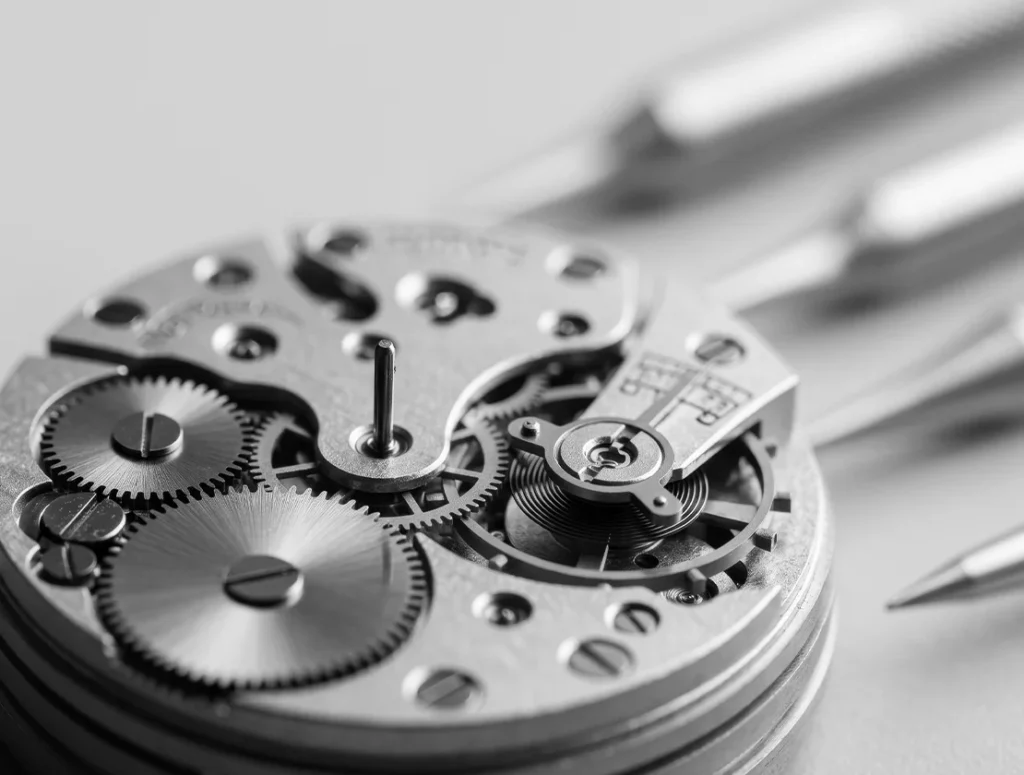
The movement is the watch. Everything else is cosmetic. A dealer opens the caseback (or, for Rolex with a non-display back, checks the movement by pull-timing on a timegrapher and cross-referencing the serial to the known caliber for that reference) and looks for four things.
Correct caliber for the reference. A Submariner 116610 should have a caliber 3135. A 126610 should have a 3235. If the movement does not match the reference, the watch either has a replacement movement (which lowers the value) or the case/dial combination is a “Franken” build (which can make it nearly unsellable through legitimate channels).
Original movement parts. On a Rolex, the rotor should carry the Rolex crown, the correct serial range should appear on the movement plate, and the finishing should match Rolex factory quality. On a Patek, the Geneva Seal or Patek Philippe Seal markings should be present and correct for the era.
Health of the movement. A timegrapher reading gives amplitude (how far the balance wheel swings) and rate (how many seconds per day the watch gains or loses). A healthy caliber 3135 reads 270+ degrees of amplitude and stays within COSC tolerance (minus 4 to plus 6 seconds per day). Low amplitude or erratic rate means the movement needs service.
Service history. A watch with a recent Rolex service (or a certified independent service with documentation) is worth more because the buyer inherits a clean service window. A watch that has been running but never serviced in 15 years may need $800 to $1,500 in service work. The offer adjusts accordingly, and rightly so.
Originality is the most argued-about factor in watch valuation because it becomes subjective in the edge cases. The clear cases are easy: an unpolished case with factory finishing intact is more desirable than a polished one, because polishing removes metal and softens the edges that the manufacturer milled to specific tolerances. But how much does one light polish cost the valuation?
On a modern Submariner, a single professional polish might reduce the value by $300 to $500. The piece still trades well, the polish is cosmetically pleasant, and most buyers in this segment do not penalize it heavily. On a vintage Paul Newman Daytona, any polish to the case can cost $5,000 to $10,000 or more, because the collector market for these references heavily penalizes any alteration. Context matters.
Dials: the key question is whether the dial is original to the watch. A replaced dial, even a genuine Rolex service dial (which Rolex installs during service if the original is damaged), changes the character of the piece. On modern references, the impact is modest ($200 to $500). On vintage references with desirable dial variants (tropical dials, gilt dials, spider dials), a replaced dial can cut the value in half. Hands follow the same logic: original hands with matching lume patina are part of the package. Replaced hands are common after service, but they reduce collector appeal.
The general rule: the fewer things that have been changed from the way the watch left the factory, the higher the grade. This principle applies across all brands, but it hits hardest on Rolex and Patek where the collector markets are deepest and the premiums for originality are widest.
This is the question every seller asks when they see two listings of the same reference at different prices. The answer is always a combination of the factors above: one piece has better condition, better documentation, or a more desirable dial variant. Even among pieces that appear identical in listing photos, subtle differences in case sharpness, bracelet stretch, and dial originality create real price gaps.
But there is also a factor that has nothing to do with the watch itself: the venue. A dealer selling direct to a collector through their own platform can price higher than a dealer wholesaling the same piece to another dealer. Chrono24 listings (consumer-to-consumer or dealer-to-consumer) typically run 10 to 20 percent above dealer-to-dealer pricing. Auction results on exceptional examples can run even higher because of competitive bidding dynamics.
When a seller compares the price they were offered to a Chrono24 listing, they are often comparing a dealer-buy offer (which reflects wholesale economics: authentication, holding cost, marketing, resale risk) to a retail asking price (which reflects the highest possible market for a piece the seller has already decided to list and wait on). Those are two different markets, not evidence that the dealer is underpaying. Understanding this distinction is the single most useful thing a seller can learn about watch valuation.
How Much Is My Rolex Worth
Box and Papers Explained
If you want to see how these four checks work on your watch, our authentication page walks through each step with photos and timelines. Or send us the reference and a few images, and we will walk you through the valuation on your specific piece. No cost, no obligation.